
Criminal Court Cases in Spartanburg County
Spartanburg County criminal court cases do not all begin and end at one desk. The Court of General Sessions is the criminal division of Circuit Court and hears felony and higher criminal prosecutions in the Seventh Judicial Circuit. The Clerk of Court keeps those filed case records at the county courthouse. Magistrate courts handle summary criminal matters and perform early bond or preliminary functions. Municipal courts keep lower-level city and ordinance cases within their own jurisdiction. A single event can therefore create a bond record in one court and a prosecution file in another.
The court file begins once a charge reaches a court. It is distinct from the officer's report and the detention booking. The filed charge can also differ from the intake charge. Readers who need the initial custody event can compare the docket with the county's Spartanburg County arrest search channels, but the clerk's case file controls the judicial history. Court name, case number, filing date, charge, event log, disposition, and sentence are the key parts of that history.
Spartanburg County General Sessions Court
General Sessions gives Spartanburg County felony records their local court home. The South Carolina Judicial Branch description of Circuit Court identifies General Sessions as its criminal side. South Carolina uses felony classes A through F and misdemeanor classes A through C, though exempt offenses keep their own statutory penalties. The charged offense statute controls. The primary courthouse is at 180 Magnolia Street, Spartanburg, SC 29306. The Seventh Circuit Solicitor represents the state in cases filed in Spartanburg and Cherokee counties, while the clerk receives and preserves the docket and filed papers.
Lower-level records may be elsewhere. The central Spartanburg Magistrate is in Room 105 at 180 Magnolia Street and can be reached at 864-596-2564. Bond Court is at 950 California Avenue, 864-596-3424. Region 1 is at 5854 Reidville Road, Suite C, in Moore; Region 2 is at 2144 Highway 292 in Inman; and Region 3 is at 112 Foster Street in Cowpens. The official Spartanburg County court roster is the best source for the current judge, address, and telephone details before a visit. The Seventh Circuit Public Defender serves qualifying people who face possible incarceration in General Sessions and several lower courts; its Spartanburg office is in Suite 2137 at 180 Magnolia Street, 864-596-2561.
Note: A bond or preliminary record may identify an early charge without showing the final General Sessions disposition.
Spartanburg County Case Record Searches
The free South Carolina Judicial Branch Case Records Search is the first online channel for Spartanburg County court cases. Select Spartanburg County and use the Public Index in a current browser. Cookies and JavaScript must be enabled, and a browser may need to allow pop-ups for the case-detail window. The Judicial Branch warns that some municipal records appear, but not every municipal court participates. No ordinary public search fee or account is advertised.
- Open the Judicial Branch entry page and select Spartanburg County rather than a nearby county or a federal court.
- Search with the case number when known. Otherwise use the party name and narrow the result with available case metadata.
- Confirm the court, filing date, case type, and party role before treating a similar name as the correct case.
- Open the case detail and read the charge, docket events, hearings, disposition, bond, counsel, and sentence fields that are publicly shown.
- Ask the Clerk of Court or the correct summary court for missing pages, older material, or a certified copy.
The search works best when the reader treats each input as a way to narrow, not as proof of identity. The official help material supports these core routes:
| Search input | Use | Required | Spartanburg County note |
|---|---|---|---|
| County | Jurisdiction selector | Yes | Choose Spartanburg for Seventh Circuit county results. |
| Case number | Direct record key | No | Best route when copied from a notice or prior docket. |
| Party name | Name search | No | Verify court and case details before relying on a match. |
| Filing metadata | Narrowing details | No | Use the year, case type, or status controls shown in the live index. |
| Court | Venue check | No | Municipal participation is incomplete, so use a clerk fallback. |
Spartanburg County Clerk Record Fallback
An empty online result does not prove that no Spartanburg County criminal case exists. A municipal court may not participate, a browser may block the detail window, or an older file may require help from its custodian. For General Sessions, contact the Spartanburg County Clerk of Court at 180 Magnolia Street, second floor, Suite 2100, Spartanburg, SC 29306. The mailing address is PO Box 3483, Spartanburg, SC 29304. The telephone is 864-596-2591, the fax is 864-596-2239, and posted hours are Monday through Friday, 8:30 a.m. to 5 p.m.
The county's official Clerk of Court directory shows the counter details used for this Spartanburg County fallback.
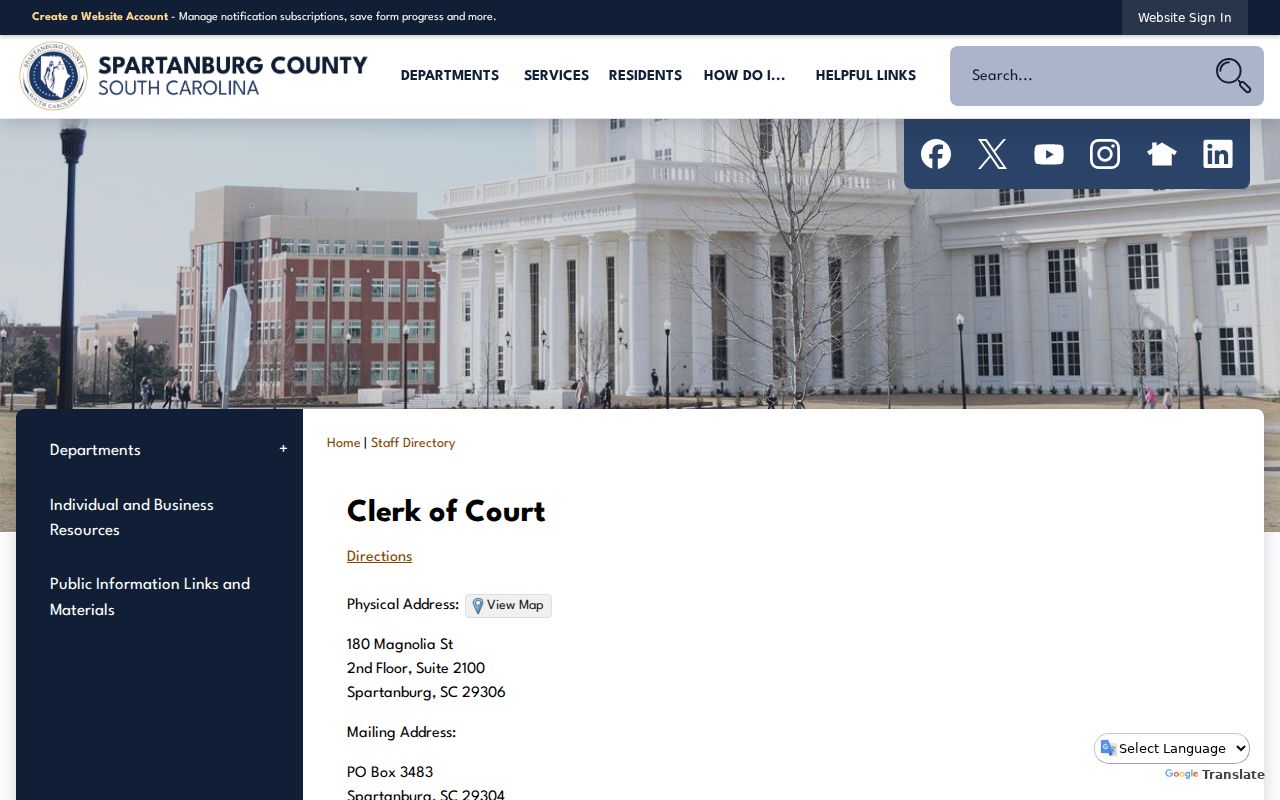
The clerk image reinforces that case-copy questions belong with the court custodian, not with the jail or arresting officer. Have the name, approximate filing year, court, and case number ready if known. For a summary case, use the Judicial Branch roster to call the right magistrate or municipal court instead of asking the circuit clerk to locate a file it does not hold.
What a Criminal Case File Contains
A Spartanburg County case file is organized around one prosecution. Public fields vary by court and case, but the Judicial Branch index and clerk file can expose the judicial steps that an arrest card cannot. Read the full event sequence. A charge line alone does not show whether the prosecutor continued it, changed it, dismissed it, or obtained a conviction.
| Case number and court | Identifies the judicial file, venue, and court division responsible for it. |
|---|---|
| Filing and case status | Shows when the matter entered court and whether it remains open or has reached an outcome. |
| Parties and counsel | Lists public party roles and attorneys where the court displays them. |
| Charges and instruments | Shows filed charges and may reflect an indictment or another charging document. |
| Docket events and hearings | Records arraignment, motions, settings, pleas, trial events, and other court action. |
| Bond | May state the bond decision or related early court action without resolving guilt. |
| Disposition and sentence | Records the outcome and, after conviction, the sentence and stated conditions where public. |
A disposition is the case outcome. It should be read beside the exact count and docket date. One Spartanburg County case can contain more than one charge, and each charge may end in a different way.
Reading Spartanburg County Court Outcomes
South Carolina docket terms carry precise meanings. A true bill means the grand jury approved an indictment. A no bill means it did not. Nolle prosequi means the prosecution discontinued that charge. An acquittal is a not-guilty result, while a disposition is the broad term for the outcome. None of those labels should be replaced with a guess based on the arrest charge.
- Indictment
- A grand-jury charging instrument used in a General Sessions prosecution.
- Arraignment
- The court stage at which the charge is stated and a plea is addressed.
- Bench warrant
- A court warrant commonly issued after a failure to appear.
- Concurrent sentence
- Sentences that run together rather than one after another.
- Consecutive sentence
- Sentences that run one after the next.
The solicitor may select charges after reviewing the officer's allegations, and a grand jury may act on an indictment. Plea terms, amendments, dismissal, or trial can change the final posture again. This is why a Spartanburg County booking label and a court disposition may not match.
Criminal Case Stages in Spartanburg County
A Spartanburg County criminal docket grows in stages. The first court record may concern bond or a preliminary matter. The solicitor then reviews a higher-level prosecution, and the grand jury may consider an indictment. Arraignment, motions, discovery issues, settings, and plea talks can follow. A trial occurs only if the case does not end sooner through dismissal, plea, or another lawful outcome.
Case flow: Charges Filed › Arraignment › Pretrial › Plea or Trial › Disposition › Sentencing
Sentencing follows a conviction rather than an arrest. Court officials should report the disposition back to SLED's Central Record Repository. A delay or incomplete report can leave the person-based repository history out of step with the clerk's current docket, so the Spartanburg County court file remains the best source for the case's judicial outcome.
Note: The charge first written at booking can change before indictment, plea, trial, or final disposition.
Federal Court Cases Beyond Spartanburg County
PACER is for federal dockets, not Spartanburg County General Sessions cases. Federal criminal matters in the area belong to the U.S. District Court for the District of South Carolina. The nearby U.S. Attorney's Greenville office is at One Liberty Square Building, 55 Beattie Place, Suite 700, Greenville, SC 29601, and its published telephone is 864-282-2100. A name found in the state Public Index should not be assumed to represent a federal file, or vice versa.
The official PACER service requires registration and provides federal dockets and filed documents.
The PACER image marks a separate search lane from Spartanburg County court records. Current access costs $0.10 per page, generally capped at $3 for a case-specific document or report. Quarterly charges of $30 or less are waived. Court opinions and access through courthouse public terminals are free, as explained in the official PACER fee guidance.
Access Rules for Case Records
The South Carolina Freedom of Information Act supports inspection, copying, and electronic receipt of public records subject to exemptions and reasonable office rules. Court access also follows judicial rules. Appellate Court Rule 610 limits bulk or compiled court-record distributions while preserving the searches people can conduct through public court sites.
Online redaction and sealing are not the same. Juvenile material, protected victim information, sealed records, and other exempt content may be withheld. A paper file can also contain material that the remote display omits. Ask the clerk what public portion remains available rather than assuming the whole case is closed. A focused request naming the case and the needed document is more useful than a demand for a broad compiled dataset.
Spartanburg County Case Expungement Path
A dismissed charge does not always vanish from every system on its own. S.C. Code §17-1-40 governs destruction and limited sealed retention for eligible dismissed, discharged, or acquitted charges. The Seventh Circuit Solicitor administers the local expungement route. Applicants use the circuit of arrest, obtain the mandatory form, and submit it through the Spartanburg office at 180 Magnolia Street.
The order process can reach the arresting agency, jail, summary court, clerk, SLED, and other affected custodians. Eligibility and fees turn on the exact offense, history, and disposition. The county reports a common local processing period of six to eight weeks, while SLED advises allowing four more weeks after it receives the order before buying a new CATCH result to verify removal. If an eligible matter persists, SLED calls for a certified true copy of the order, a recently purchased record check, and a stamped return envelope.
A reader should preserve the case number and certified disposition before seeking review. Those details let the solicitor and Spartanburg County court identify the right count without relying on a broad name match.