
Spartanburg County Sex Offender Checks
The reliable starting point is the free South Carolina Public Sex Offender Registry Tool, known as SORT. The South Carolina Law Enforcement Division, or SLED, maintains the statewide portal. A reader may choose the name route or the geographic route after accepting the conditions and passing the verification screen. The registry is designed for public safety awareness. It is not a current surveillance feed, and a listed address should not be treated as proof that someone is at that place at a given moment.
Spartanburg County adds a local layer. The Spartanburg County Sheriff’s Office registers people within its jurisdiction and performs address verification, while SLED manages the statewide data and public display. Searchers near a county or state line should also consider whether the address or conviction may fall outside South Carolina. The official national search supplies that broader sweep. Each channel answers a distinct question, so one blank result should lead to the next official source rather than a firm claim that no duty exists.
Spartanburg Registry and CATCH Differ
SLED operates both SORT and Citizens Access to Criminal Histories, but the products are not interchangeable. The paid CATCH name check covers South Carolina criminal-history information reported to the central repository. SLED expressly excludes sex-offender-registry data from CATCH. A clear CATCH response therefore does not answer a Spartanburg County registry question. Use SORT for registration status and its statutorily public details.
The SLED registry guidance explains the state duties, reporting framework, and removal channel shown in the official source.
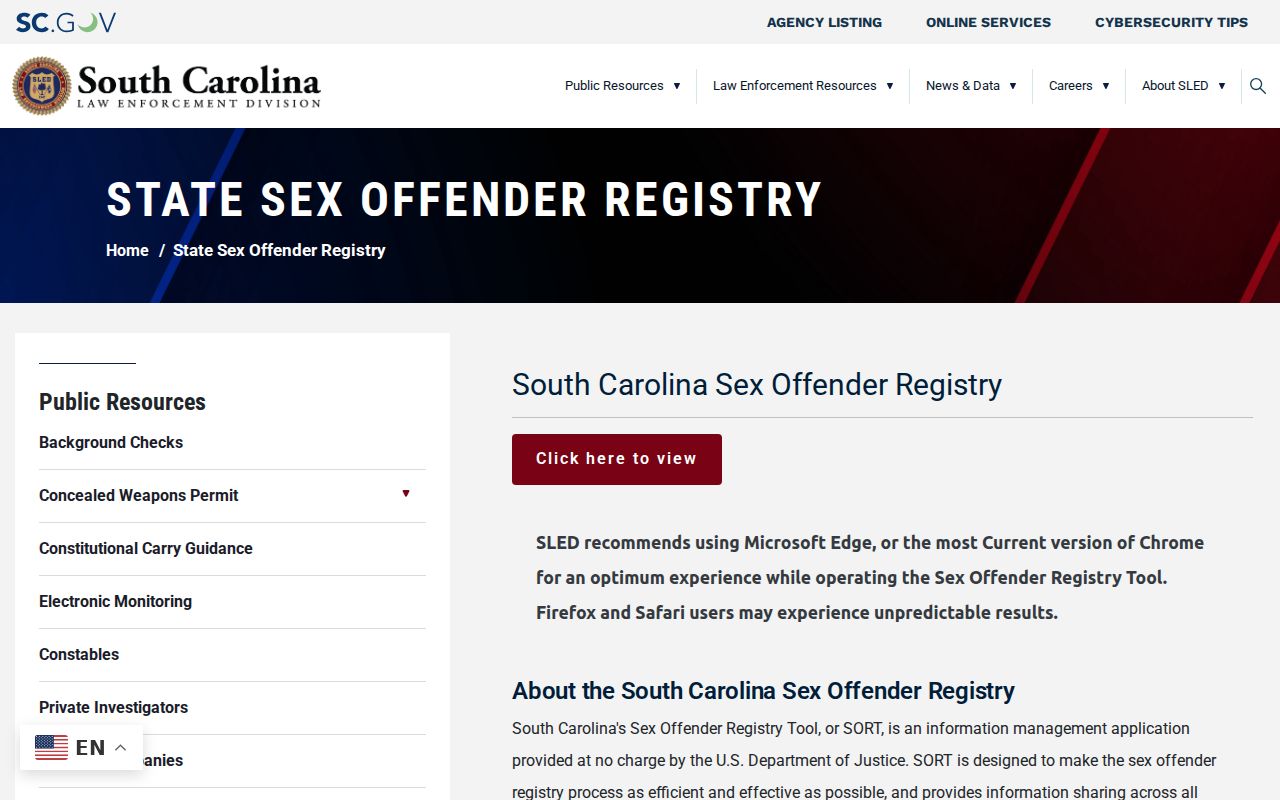
That guidance is the better source for legal duties than a CATCH receipt or a county court index because it comes from the agency charged with the registry.
The distinction matters when reviewing a person’s own records or planning for family safety. A court file describes a prosecution and disposition. CATCH organizes reported criminal-history cycles. SORT shows the public registration record. None should be substituted for the others, and a listing should not be recast as a new charge, arrest, or warrant.
South Carolina Sex Offender Registry Searches
SORT places a conditions screen and displayed verification code before its search tools. SLED recommends Microsoft Edge or the current Chrome release and warns that Firefox and Safari may not work as expected. Exact name and geographic controls can change in the live session, so use the labels displayed by the official portal rather than guessing at fields. For a Spartanburg County sex offender lookup, prepare the best name spelling or the location that matters before opening the tool.
- Open SORT, read the Conditions of Use, and select I Agree.
- Enter the displayed verification code and choose Continue.
- Select Name Search for a known registrant or Geographic Search for a place-based check.
- Compare the returned identifiers, open the relevant public profile, and read the conviction, address, photograph, and status details in context.
| Control or Field | Type | Required | How It Works |
|---|---|---|---|
| I Agree | Consent button | Yes | Accepts the posted conditions before any search. |
| Verification code | CAPTCHA text | Yes | Uses the code shown on screen before Continue. |
| Name Search | Search tab | Optional route | Opens the registrant-name path; follow the live field labels. |
| Geographic Search | Search tab | Optional route | Opens the place-based path; verify its current location controls in-browser. |
| Community Notifications | Enrollment tab | Optional | Registers for proximity notices after the verification screen. |
The official SORT entry screen shows the search gateway used for Spartanburg County records.
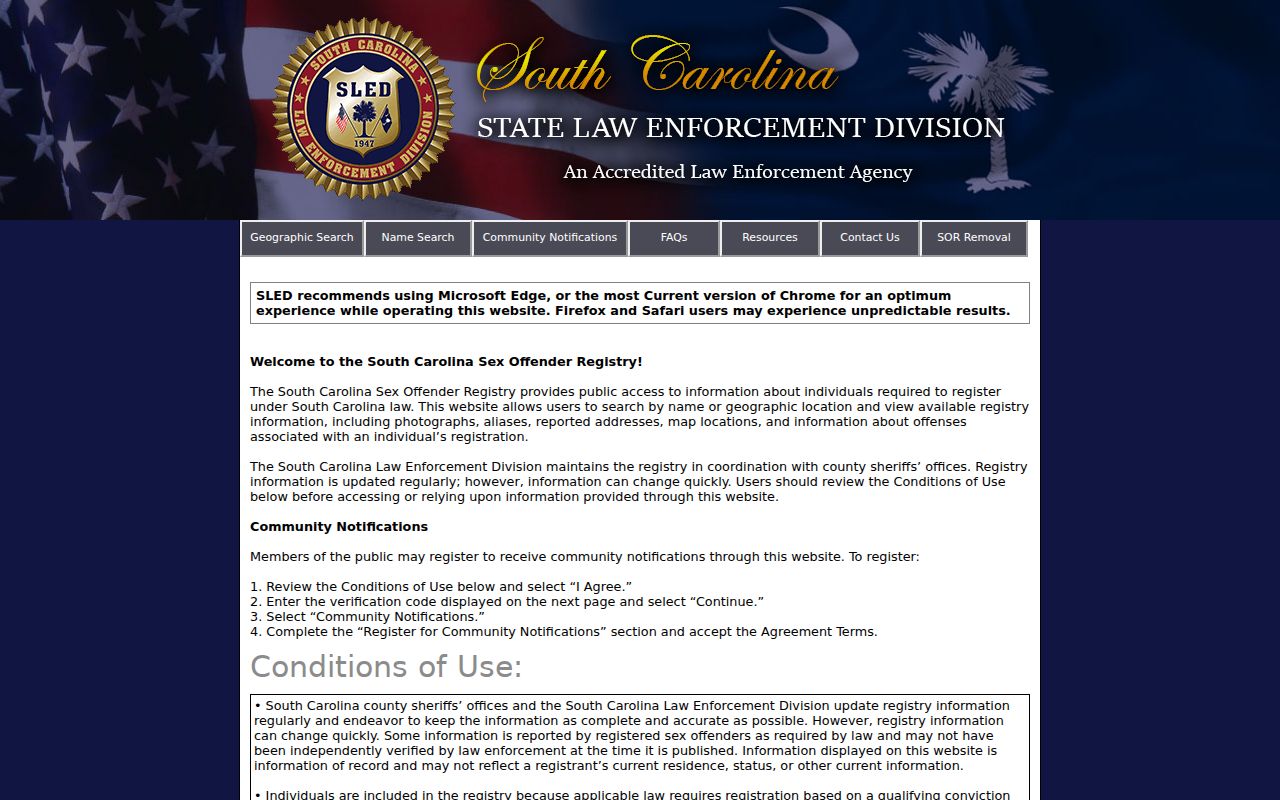
The conditions and verification steps shown there protect direct access to the name, geographic, and notification tools.
Spartanburg Registry Address Verification
The Spartanburg County Sheriff’s Office performs the local registration and address-verification work. A July 2025 County Council agenda documented a request for a Master Deputy focused on home-address checks. The unit reported that about five registrants per month were moving into its jurisdiction and that a citizen report of a possible mismatch could trigger another check. This is a concrete reason to read the portal’s own timing caveat: information can change fast and may first reflect details supplied by the registrant before local verification.
Contact the Sheriff’s Office at P.O. Box 771, Spartanburg, SC 29304, or call 864-503-4500 or 864-503-4600 about county registration and address-verification concerns. Give a precise description of the possible discrepancy. Do not confront the listed person. SLED remains the state contact for a portal correction, removal status, or registry rule question.
Community Notifications add a useful watch layer. From SORT, accept the conditions, pass the verification code, choose the notification tab, complete every registration field, and accept its agreement terms. People enrolled in the former system must enroll again in SORT. Alerts supplement a fresh search; they do not certify present location.
Note: A Spartanburg County address displayed online may precede a local field check, so report a specific concern through an official channel.
Registry Profiles: What They Show
South Carolina law identifies the core information SLED or a sheriff must disclose in response to a written or electronic request. The public set includes names and aliases, identifying physical traits, date of birth, the home address on file, the qualifying offense, conviction place and date, and a current photograph. A Spartanburg County registry profile must be read as a record of registration tied to a qualifying conviction. It is not proof of a fresh allegation or current misconduct.
| Name and Aliases | The registered name plus aliases made public under state law. |
|---|---|
| Photo and Description | A current photograph and identifying physical characteristics. |
| Date of Birth | The public birth date used with other fields to distinguish records. |
| Address on File | The registered home address reported in the official record, subject to change and verification. |
| Qualifying Offense | The offense that created the registration duty, not a claim of new conduct. |
| Conviction Details | The date, city, and state of the qualifying conviction. |
Do not assume that vehicle, school, work, scar, tattoo, victim-category, or other fields will always appear. Those details should be relied on only when the current interface actually displays them. The combination of photograph, aliases, birth date, and conviction details is more useful for identity review than a name alone.
Spartanburg Listings Need Case Context
Registry inclusion is conviction-based under South Carolina’s qualifying-offense law. That legal fact separates a listing from a new police event. The public record may remain active while no new arrest or court case exists. Likewise, a new court case does not by itself explain whether a registry duty changed. Searchers who need the filed charge, motions, plea, sentence, or later disposition should consult the Spartanburg County court case lookup as a separate record source.
A registry address also carries limits. SLED warns that county sheriffs and the state update data on a regular basis, yet changes can happen faster than the display. Some details may come from the registrant before local staff completes a check. Use the record to guide awareness and official follow-up. Do not turn a stale address, shared name, or map marker into a factual claim about present conduct.
For the same reason, no private person’s name, photograph, or profile is republished here. The official portal gives the latest public view and the context notices that travel with it.
Registration Levels and Duties in South Carolina
South Carolina is not presented to consumers as a simple federal Tier I, II, and III chart with fixed public durations. Registration, verification, and possible removal depend on the qualifying offense, the current state statute, the person’s supervision history, and any judicial determination. A generic three-row duration chart would hide those rules and could give a false end date. The safer Spartanburg County approach is to identify what the official sources actually establish.
| Rule or Status | What Is Established | What to Verify |
|---|---|---|
| Qualifying offense | State law determines whether registration applies. | Read the offense-specific provision and current registry guidance. |
| Periodic verification | Section 23-3-460 governs registration and recurring verification. | Confirm the interval that applies to the person’s legal category. |
| Sexually violent predator | A person judicially found to have this status verifies and is photographed every 90 days. | Verify the court determination and current duty with SLED. |
| Judicial removal | Removal follows the state framework and is not automatic. | Confirm offense, elapsed time, supervision history, disqualifiers, and written outcome. |
SLED’s state registry office can explain the current framework at 803-896-2601 or sor@sled.sc.gov. A registrant must keep meeting all duties unless formal action and written notice end them. An application, pending review, or assumed federal tier does not by itself cancel a South Carolina duty.
Spartanburg and National Registry Searches
SORT is the authoritative state detail source for a Spartanburg County registry check. The U.S. Department of Justice’s National Sex Offender Public Website, or NSOPW, adds a cross-jurisdiction layer. It is useful when a search may reach another state, tribal jurisdiction, territory, or the District of Columbia. This can matter around travel, a recent move, or a location near a state line.
The official NSOPW search provides the federal gateway to participating public registry systems.
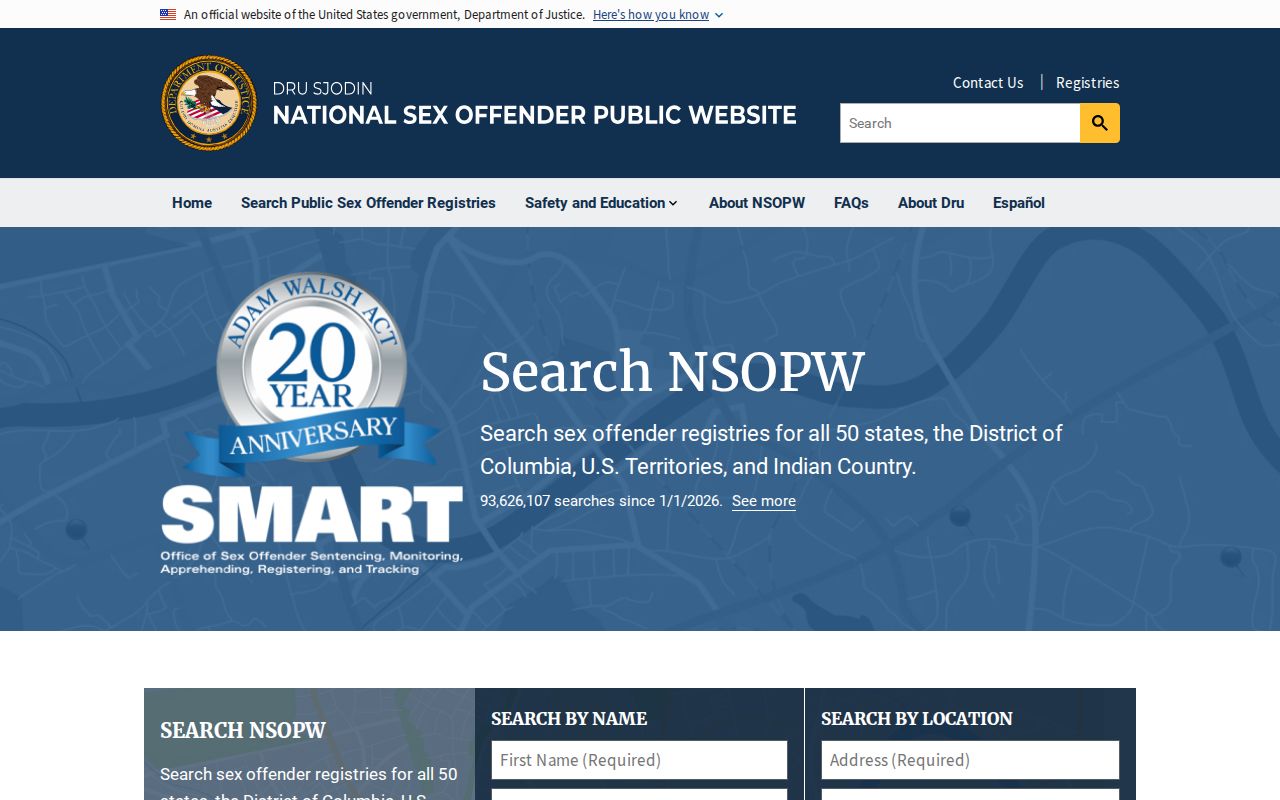
Use a national result to reach the contributing jurisdiction’s official record, then read that jurisdiction’s notices and profile details.
The two systems are complementary. Begin with SORT for South Carolina details and county verification context. Add NSOPW when the geographic question goes beyond the state. If the portals appear to disagree, preserve the identifiers and contact the agency that owns the questioned entry instead of choosing the result that seems newest.
Using Registry Information Lawfully
Registry information is meant for public safety awareness and careful planning. It may support a conversation about family routines, community notification, or a precise report to law enforcement. It does not authorize threats, intimidation, harassment, or vigilant action. Section 23-3-450 of the South Carolina Code provides penalties when someone commits a criminal offense using registry information.
Use the registry lawfully: Never harass, threaten, intimidate, or confront a listed person. Misuse tied to a criminal offense can carry penalties under S.C. Code §23-3-450.
Report suspected noncompliance to the Spartanburg County Sheriff or SLED. Give the agency a clear location, date, and description of the apparent conflict. An official report lets trained staff compare the tip with the registration file and conduct any needed address check. It also avoids spreading an unverified claim through a neighborhood or online group.
Correcting Spartanburg Registry Information
When a Spartanburg County profile appears wrong, first identify the exact field at issue. Note whether the concern involves an alias, photograph, conviction detail, registration status, or address on file. Save the official page address and the time of review. A precise correction concern is more useful than a broad claim that the whole profile is false.
Contact SLED’s Sex Offender Registry office at P.O. Box 21398, Columbia, SC 29210; telephone 803-896-2601; fax 803-896-2311; or email sor@sled.sc.gov. For a possible local address mismatch or registration issue, the Spartanburg County Sheriff’s Office is the county contact. Keep using the existing public record with care while the agencies check it.
Removal is a legal process, not a correction button. South Carolina’s framework depends on offense and case-specific facts, and registration duties continue during review. Only a formal outcome should be treated as ending the duty. When the state updates a record, return to SORT and confirm the current public display rather than relying on an old screenshot.